
Yes, Back Yard Burgers closed hundreds of locations—collapsing from roughly 160 restaurants nationwide to just seven by 2025. Two bankruptcies in 2012 and 2023 triggered massive closures, but private equity mismanagement damaged the chain significantly. Leadership changes meant smaller burger patties, ditched seasoned fries, and confusing brand shifts that drove customers away. Kansas City lost all its nearly dozen locations by mid-2024. What’s left clusters mostly in Memphis, Tennessee, with scattered outposts elsewhere. The chain’s survival story has noteworthy twists worth exploring further.
[link-whisper-related-posts]Yes, Back Yard Burgers Closed Hundreds of Locations Since the 1990s Peak
While Back Yard Burgers once boasted roughly 160 locations across the United States at its peak, the chain’s story took a sharp downturn over the following decades. You’ve probably noticed fewer of these burger joints around lately, and there’s a reason why. The company filed for Chapter 11 bankruptcy in 2012, carrying about $62 million in debts while only holding $13 million in assets. That bankruptcy led to the closure of around 22 stores, and it was just the beginning. Things didn’t improve much either. A second bankruptcy filing came in July 2023 when roughly 20 locations remained operating. By December 2024, after emerging from Chapter 11, the chain had dwindled significantly. Today, only seven locations survive, scattered across different states. It’s a difficult journey to witness.
The Bankruptcy Filing of July 2023 Triggered the Most Recent Wave of Closures
What happens when a struggling restaurant chain reaches its breaking point? For Backyard Burger, that moment came in July 2023 when the company filed for Chapter 11 bankruptcy. At that time, only 20 locations remained operating—a stark contrast to their former glory. This bankruptcy filing triggered the most recent wave of closures, accelerating the chain’s decline across multiple states. The proceedings forced difficult decisions about which locations could survive and which couldn’t. Stores in the Mississippi region and Memphis area faced particularly tough challenges during this period. By the time the company emerged from bankruptcy in December 2024, their footprint had shrunk dramatically further. That July filing sealed the fate of many remaining restaurants, reducing Backyard Burger to a shadow of its former self.
From 160 Locations Nationwide to Fewer Than 10 by 2025
The story of Backyard Burger’s collapse didn’t happen overnight—it’s a sobering reminder of how quickly a once-thriving restaurant chain can fail. What started as roughly 160 locations nationwide dwindled dramatically through a series of Chapter 11 filings and subsequent closures.
Here’s what happened:
- The 2012 bankruptcy triggered initial store shutdowns across multiple states
- A second Chapter 11 filing in 2023 accelerated further decline
- By late 2024, emergence left only seven surviving locations
You’re watching a chain lose over 95% of its footprint. Four Memphis-area locations remained operational, alongside scattered sites in Mississippi, Tennessee, Florida, Illinois, and North Carolina. This dramatic contraction illustrates how corporate restructuring, ownership changes, and market pressures can reshape even established regional favorites that once had widespread presence.
How Did the Chain’s Rapid Expansion Create Unsustainable Growth?
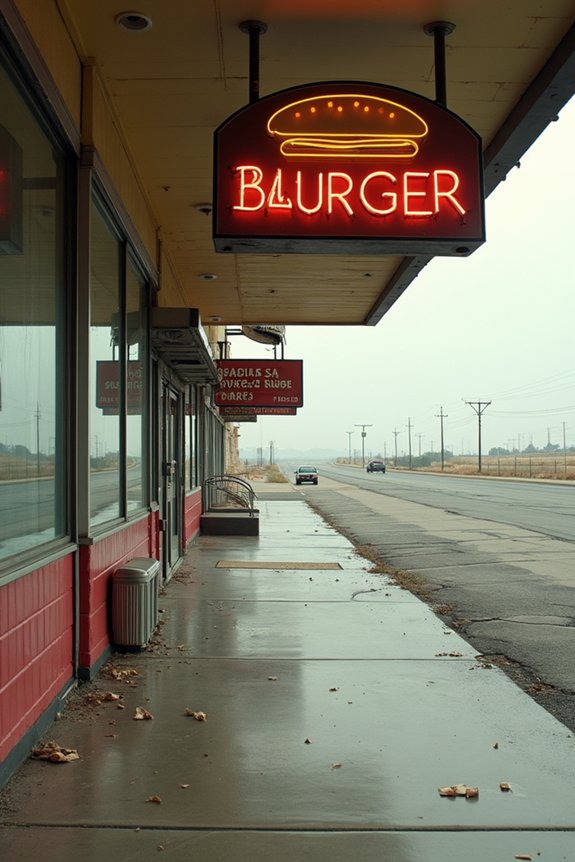
Ever wonder why some restaurants grow so fast they actually collapse under their own weight? That’s basically what happened to Backyard Burger. The chain expanded aggressively during the 1990s and early 2000s, jumping from Cleveland, Mississippi into numerous southern states plus Illinois. They grabbed four franchise interests within 90 days—talk about moving fast! Then came the co-branding deal with Yum! Brands in 2002, targeting 500 locations nationwide.
| Growth Phase | Locations | Strategy | Result |
|---|---|---|---|
| 1990s-2000s | Rapid expansion | Multi-state growth | Overextension |
| 2002 | Growing | Yum! co-branding | Strained finances |
| 2010s | Declining | Cost-cutting | Smaller portions |
| 2012 | Collapsing | Chapter 11 | $62M debt |
Here’s the thing: expansion doesn’t automatically mean success. Backyard Burger stretched too thin, financially speaking.
Why Did Corporate Restructuring and Private Equity Changes Weaken Operations?
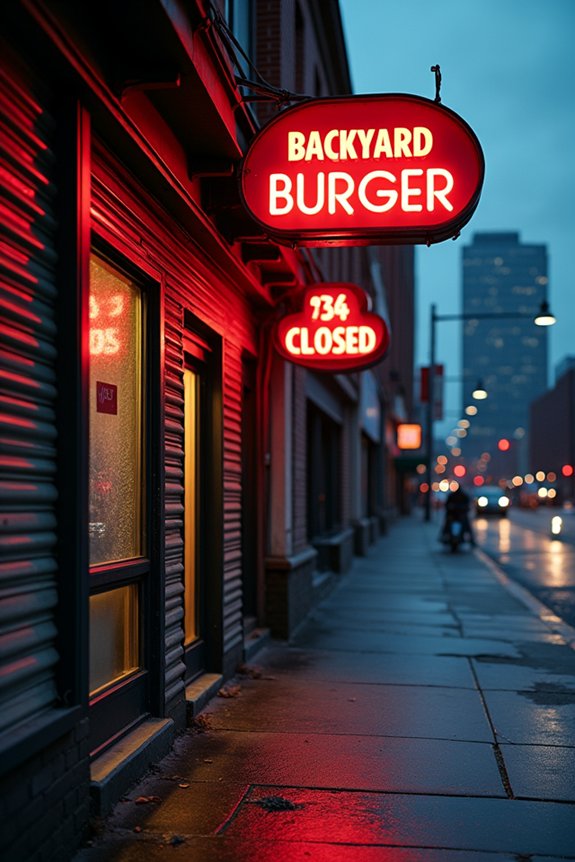
When private equity firms like C. Stephen Lynn’s group took over in 2007 and Axum Capital Partners seized control in 2017, the chain’s focus shifted away from what made it special—founder-driven decisions gave way to cost-cutting moves like shrinking burger patties and ditching seasoned fries that customers valued. These ownership transitions created a leadership vacuum; executives came and went (Reid Zeising departed in 2009), leaving the company without consistent direction to navigate the restaurant industry’s intense competition and shifting customer preferences. The constant strategic shifts meant Backyard Burgers couldn’t build momentum or customer loyalty, ultimately contributing to the two bankruptcies in 2012 and 2023 that left the once-promising chain with just seven locations by 2024.
Ownership Transitions And Instability
Multiple ownership changes and private equity involvement destabilized Backyard Burger’s operations over the years, making it difficult for the chain to maintain consistent direction. These ownership transitions created real challenges that impacted the brand’s stability:
- 2007 buyout by C. Stephen Lynn and Reid M. Zeising shifted the company’s focus and priorities without clear strategic alignment
- 2017 Axum Capital Partners takeover brought corporate headquarters from Memphis to Nashville, signaling another major restructuring
- Dual bankruptcy filings in 2012 and 2023 revealed how ownership instability weakened operations and customer confidence
Each transition meant new leadership, new strategies, and new uncertainty. When a company constantly changes hands, maintaining the restaurant quality and consistency customers expect becomes problematic. That instability eventually caught up with Backyard Burger, contributing to significant store closures and financial strain throughout the chain’s later years.
Strategic Decisions Under New Leadership
Why’d private equity firms think constant restructuring would save Backyard Burger? They believed aggressive cost-cutting and portfolio rationalization would turn things around, but the strategy backfired.
| Year | Leadership Change | Strategic Action |
|---|---|---|
| 2013 | New CEO appointed | Introduced new financing |
| 2017 | Axum Capital Partners | Controlling stake acquired |
| 2020 | Dennis Pfaff | Cost-cutting initiatives |
| 2023 | Ongoing leadership | Filed for bankruptcy |
| 2024 | Restructured team | Emerged with 7 locations |
Multiple CEOs—Doug McDougall, Scott Shotter, and Dennis Pfaff—implemented different visions, yet none prevented bankruptcy filings. Each leadership transition brought fresh cost-cutting plans, yet the chain lost locations regardless. The 2012 bankruptcy closed 22 stores; the 2023 filing damaged operations significantly. Relentless restructuring without a coherent vision accelerates decline rather than preventing it.
The 2012 Bankruptcy: First Warning Sign of Structural Problems
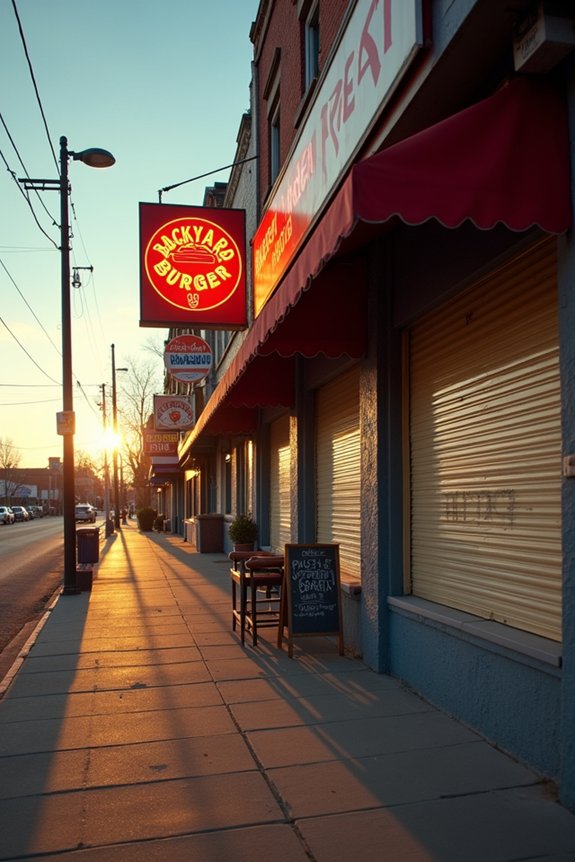
In October 2012, Backyard Burgers filed for Chapter 11 bankruptcy with $62 million in debt against just $13 million in assets, revealing that years of rapid expansion had created serious structural problems the company couldn’t sustain. The restructuring forced tough decisions: about 22 locations closed their doors, new leadership took the helm, and fresh financing kicked in when the chain emerged in January 2013. These changes signaled that something fundamental had gone wrong with how the business operated. This bankruptcy was the first major warning sign that deeper issues with corporate strategy and operations would continue to affect Backyard Burgers in the years ahead.
Financial Collapse and Debt
When October 2012 rolled around, Back Yard Burgers faced a financial reckoning that shook the foundation of the entire chain. The company filed for Chapter 11 bankruptcy carrying roughly $62 million in debts against just $13 million in assets. That’s a gap you can’t ignore.
Here’s what happened:
- The debt-to-asset ratio revealed serious mismanagement and operational inefficiencies throughout the system
- Approximately 22 store closures occurred during restructuring, eliminating jobs and reducing the chain’s footprint nationwide
- The filing signaled deeper structural problems that had been festering beneath the surface for years
This bankruptcy represented the first major warning sign. The company had shifted headquarters from Memphis to Nashville in 2007, yet financial troubles persisted. The chain faced real operational challenges that required drastic measures to survive.
Store Closures and Restructuring
How’d things get so bad so fast? When Backyard Burgers filed for Chapter 11 bankruptcy in October 2012, the company faced a harsh reality: $62 million in debts against just $13 million in assets. That gap forced difficult decisions. About 22 store closures happened during the restructuring period, marking the company’s first real warning sign of deep structural problems. This wasn’t just one underperforming location—it revealed systemic financial trouble throughout the chain. The restructuring meant significant downsizing of Backyard Burgers’ footprint. By January 2013, they’d emerged from bankruptcy with new financing and fresh leadership, but the damage was done. Those store closures taught the company and investors alike that something fundamental needed fixing, not just surface-level adjustments.
Corporate Leadership Transitions
Beyond the numbers and store closures, Backyard Burgers’ real crisis was happening in the executive suite. When long-time chairman Reid M. Zeising resigned in February 2009, the company faced its first significant leadership instability. Then came the October 2012 bankruptcy filing—a watershed moment revealing deeper structural problems. Here’s what unfolded:
- Executive departures signaled internal dysfunction that investors couldn’t ignore
- New CEO arrival in January 2013 represented a shift in leadership direction after bankruptcy emerged
- Headquarters relocation from Memphis to Nashville reflected the company’s strategic pivot toward recovery
The urgency in these moves was apparent. The bankruptcy wasn’t just about money; it exposed how leadership gaps had weakened the company from within. These transitions showed Backyard Burgers was fighting to rebuild trust and direction simultaneously.
Menu Changes and Cost-Cutting Measures Alienated Longtime Customers
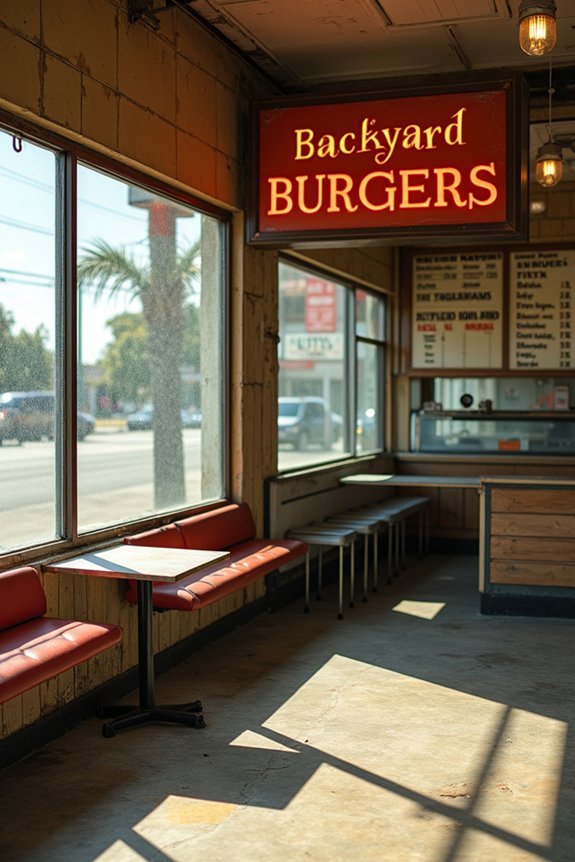
What happens when a beloved burger joint decides to tighten its belt? Under private equity ownership, Back Yard Burgers implemented drastic menu changes and cost-cutting measures that fundamentally altered the experience longtime customers cherished. The brand reduced patty sizes and streamlined offerings, prioritizing profits over quality. These decisions backfired.
| Change | Impact |
|---|---|
| Smaller patties | Lost loyal customers |
| Reduced menu options | Simplified operations |
| Interior remodels | Mixed customer reception |
| Exterior signage changes | Brand identity confusion |
I get it—running a restaurant is expensive. But when you strip away what made Back Yard Burgers special, you’re telling your community you don’t value them anymore. That message was loud and clear, driving people toward competitors who still honored their heritage and customers’ expectations.
Mississippi Locations Hit Hardest, Including High-Performing Madison Unit
The ripple effects of those menu cuts and cost-saving moves hit Mississippi’s Back Yard Burgers locations particularly hard. If you’re familiar with the state’s restaurant scene, you likely noticed the changes.
Here’s what happened across Mississippi:
- The Madison location—which was actually the chain’s best performer—closed in early May 2023, disappointing loyal customers who’d made it their regular spot
- Multiple sites in Jackson, Gulfport, Meridian, Flowood, and Byram shut down abruptly during mid-2023 restructuring
- The Batesville unit rebuilt itself as a new prototype after closing around late 2020, only to face ongoing challenges
Kansas City Area Lost All Presence by Mid-2024
Gene Scassellati’s retirement from the company’s leadership left a leadership vacuum that, combined with corporate bankruptcy filings, made it nearly impossible to sustain the Kansas City market presence. The chain’s financial troubles hit this region particularly hard—by May 2024, the last remaining KC locations had shut their doors, marking a complete exit from a market that once held multiple units. This final chapter in Kansas City demonstrates how corporate instability and ownership transitions can rapidly dissolve even established regional footprints.
Gene Scassellati’s Retirement Decision
How’d we get here? Gene Scassellati’s retirement decision became the turning point for Kansas City’s Back Yard Burgers locations. When Scassellati stepped away from owning the KC-area restaurants, the dominos started falling. Here’s what happened next:
- Corporate didn’t repurchase the Kansas City locations after his retirement
- Scassellati sold the physical buildings housing the restaurants
- The chain filed for bankruptcy in 2012, accelerating the decline
We watched nearly a dozen locations shrink down to nothing. By mid-2024, Kansas City had completely lost its Back Yard Burgers presence. His retirement wasn’t just a personal decision—it triggered a chain reaction that reshaped the entire market. It’s a clear example of how local ownership matters for keeping beloved restaurants around in our communities.
Corporate Bankruptcy’s Local Impact
When Backyard Burger filed for bankruptcy in 2012, it didn’t just shake up the corporate office—it fundamentally changed what Kansas City lost. The closures rippled through our community faster than anyone expected. Nearly a dozen KC-area stores had thrived at their peak, but the bankruptcy triggered a domino effect of shutdowns. Local owners like Gene Scassellati faced tough decisions about their locations. By mid-2023, most buildings had vanished from our terrain, either sold off or repurposed into something else entirely. The corporate restructuring didn’t stop there—it accelerated. By May 2024, Kansas City had effectively lost all Backyard Burger presence. What once felt like our neighborhood burger spot became a memory. That’s how bankruptcy’s local impact really plays out for communities like ours.
Final Closures And Timeline
The bankruptcy filing didn’t just reshape the corporate structure—it set a clear countdown clock for Kansas City’s Backyard Burger era. By mid-2024, we’d watched the final curtain fall on all local locations, marking the end of an era that once felt permanent.
Here’s how it unfolded:
- Nearly a dozen Back Yard Burgers locations dotted the KC landscape at their peak
- Gene Scassellati attempted selling buildings back to corporate, but they declined the offer
- The 2023 bankruptcy accelerated closures throughout 2023 and into 2024
The closures weren’t isolated to Kansas City—they reflected a nationwide contraction from roughly 160 locations to a skeletal footprint. The dominoes fell, one location after another, until nothing remained. Seeing beloved burger joints vanish is difficult, but that’s the reality many communities faced.
Franchise Owners Like Gene Scassellati Chose Retirement Over Corporate Uncertainty
Why’d some franchise owners decide enough was enough? Gene Scassellati, who ran Back Yard Burgers locations in Kansas City, faced a tough choice. He announced his retirement and tried selling back to corporate, but they declined the offer. Rather than wrestling with uncertainty, he sold the buildings themselves. His decision reflected a larger pattern among franchise owners navigating corporate restructuring.
| Challenge | Impact | Owner Response |
|---|---|---|
| Corporate uncertainty | Unclear future direction | Sought exit strategies |
| Co-branding shifts | Complicated operations | Evaluated retirement |
| Ownership transitions | Financial pressure | Sold assets |
| Market decline | Reduced profitability | Left market |
| Bankruptcy concerns | Risk exposure | Chose independence |
Scassellati’s move wasn’t unique. When corporate stopped supporting local franchisees like him, retirement became the smarter play than fighting corporate indecision.
What Remains: Scattered Locations in Tennessee, Florida, Illinois, and Mississippi
As franchise owners like Gene Scassellati stepped away from the fight, Backyard Burger’s footprint shrunk dramatically across America. By 2024–2025, only seven Back Yard Burgers remained, scattered across the country. Bankruptcy and corporate uncertainty reshaped the chain’s trajectory.
What’s left standing:
- Four locations clustered in the Memphis area, maintaining the brand’s presence in its strongest market
- Three remaining outposts across Tennessee, Florida, Illinois, and Mississippi—each one a survivor
- A drastically reduced U.S. footprint, down from nearly a dozen Kansas City stores and multiple Mississippi locations
These surviving restaurants demonstrate persistence. They’re evidence that even through contraction, some communities still value what Back Yard Burgers represents—genuine burgers and local connection.
Could Back Yard Burgers Survive, and What Would Revival Require?
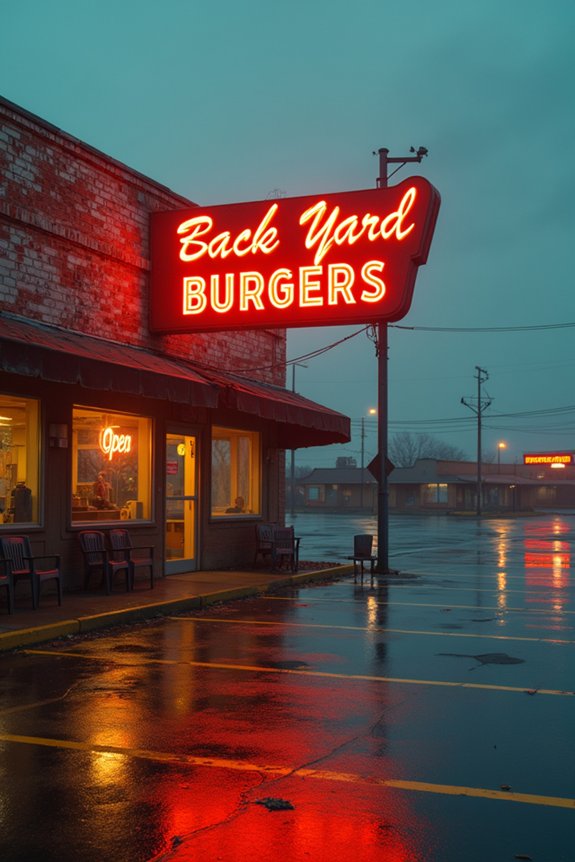
Can a burger chain that’s been knocked down come back stronger? I think Back Yard Burgers might have a shot. Sure, bankruptcy in 2012 nearly finished them off, but here’s what catches my attention: they’re still fighting. Their 2025 Memphis grand reopening campaign shows they’re not just limping along—they’re strategizing.
Here’s what revival actually requires. First, they need consistent quality at those seven remaining locations. Second, they’ve got to rebuild community trust through word-of-mouth. Third, smart expansion matters more than rapid growth.
I’ll be honest—the road’s steep. But with focused operations in Tennessee, Mississippi, and beyond, plus genuine momentum in Memphis, I see potential. Sometimes a leaner, hungrier version of a brand succeeds where the bloated original failed.